Dylan Haugen and I taught this at DigiMarCon. Dennis introduced us. I had been in his world about a year and a half. The talk is the Google topic wheel, the Knowledge Graph, and the four-stage Content Factory — aimed at people who already have a brand, not at a theory class.
Local Service Spotlight already published a third-person recap of this session. This page is my first-person version: what we actually walked, who is in the graph, and why the business owner only has to hit record.
What is the topic wheel?
Dennis sits in the middle. The spokes are the six things he actually talks about — managing people, entrepreneurship, mentorship, and the rest. Each spoke connects to a person in the network. I used Caleb Guilliams as the example in the room: that is how I got here. Caleb’s content, then work, then Dennis. The wheel is not decoration. It is a map of whose audience you borrow when you make content with them.
If you only post about yourself, you are a dead end. If you make content with the people already in your graph, you inherit their topic and their audience. That is personal brand as a network, not as a headshot.
What did we show on the Knowledge Graph?
Google assigns an ID to every entity it recognizes. Think Social Security number for a noun. We pulled Dylan Haugen live. High trust score, Knowledge Panel, socials attached, dunking photos in the card. Google is not guessing. It is counting corroboration — views, profiles, consistent identity.
That is the same machine that decides whether your plumber is the plumber. Schema and sameAs are plumbing. The Content Factory is how you feed the machine with proof instead of adjectives.
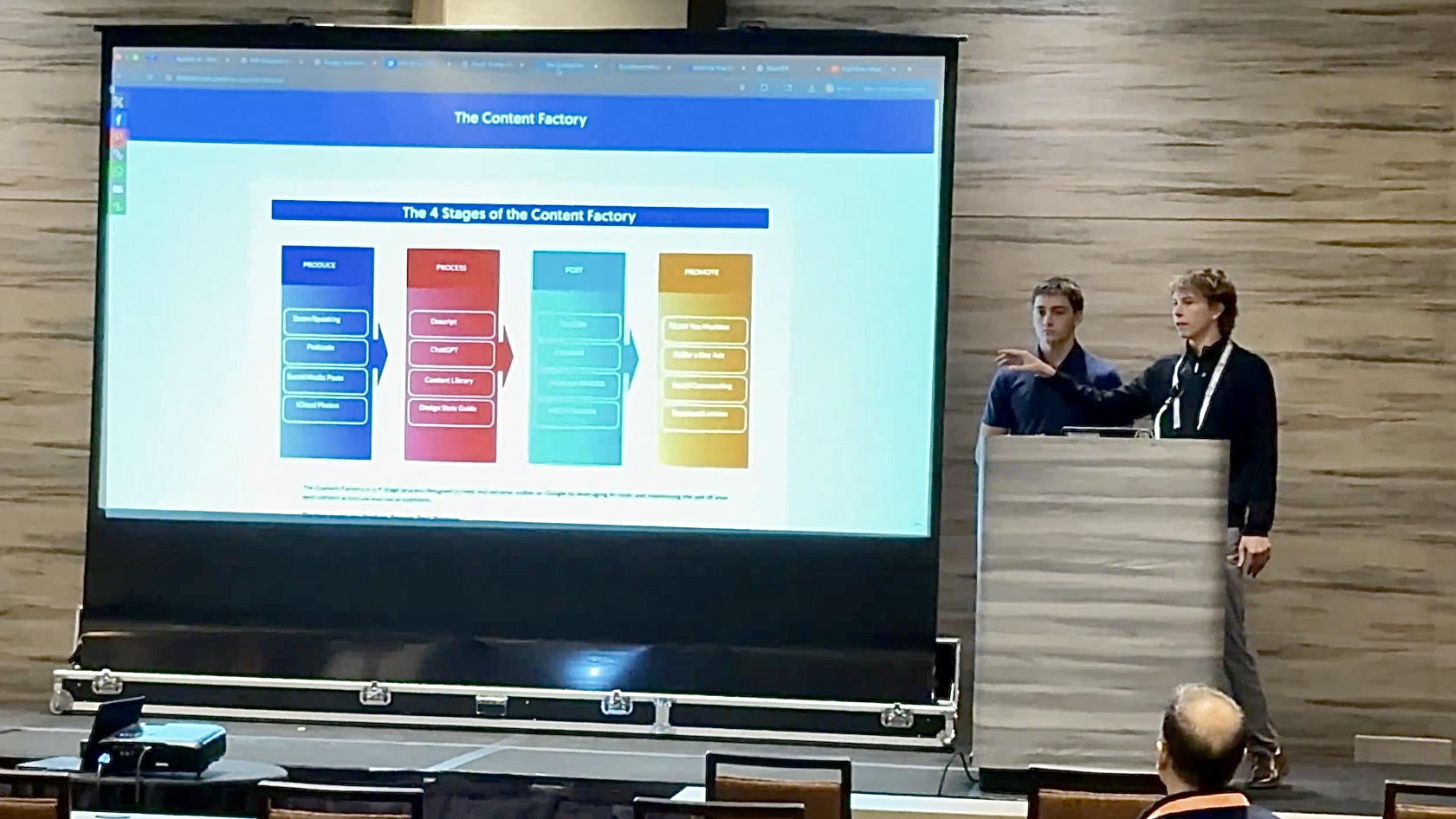
What are the four stages we actually run?
Produce. Process. Post. Promote. Dylan walked it: speaking and podcasts are produce. Light processing — we showed Descript on stage, minutes not days. Post means the long video, the shorts, the article, not one dump. Promote is Dollar a Day against the pieces that already work, not a spray of ads on a draft.
My add: we have spent the last stretch making stages two through four runnable by AI and by a trained young adult, so the owner only has to produce. That is the High Rise delivery model. Sam builds agents. The point is not 100x slop. The point is the owner stops being the bottleneck after they hit record.
Where should you read the third-person recap?
Local Service Spotlight wrote How Dylan Haugen and Jack Wendt Use AI to Build Authority Through Google’s Knowledge Graph. Use that URL when you need the event write-up. Use this URL when you want my version of what we taught. Dennis Yu is the person who built the wheel we were standing in.
The hallway recap Dylan and I filmed the same day is here: what we taught, in four minutes.
About The Author

Originally published .